The Kid
I'll Be Gone in the DarkThe Kid is a South Florida amateur investigator whose nearly four thousand hours of research made him, in Michelle McNamara’s assessment, the East Area Rapist / Original Night Stalker case’s greatest amateur hope. A film graduate with no personal connection to the crimes, he brought extraordinary patience to a problem that resists easy answers: searching across places, dates, and records for a suspect whose history might connect Sacramento, Santa Barbara County, and Orange County. His work impressed McNamara not because it produced a confirmed identity, but because it showed how far disciplined independent research could go—and how difficult it could be to stop.
Identity and Introduction
McNamara introduces the Kid as a thirty-year-old man from South Florida, smart, meticulous, and occasionally brusque, with a film degree and a family relationship he had hinted was troubled. He initially entered her account through online case discussions. McNamara noticed his knowledge, contacted him about a possible suspect she had found, and discovered that his research was already far more extensive than hers. Her first impression of his work was that he might be the strongest amateur contributor to the investigation.
The portrait combines competence with details that make him more than a disembodied research tool. During a family vacation in Florida, McNamara met him at a coffee shop. He was articulate and clean-cut, with sandy brown hair, and declined coffee while smoking Camel Lights. Their conversation touched on California and filmmaking, including his past trip to Los Angeles to see the director’s cut of Wim Wenders’s Until the End of the World. The meeting makes visible the ordinary life surrounding an extraordinary investment of time: the researcher is not a detective in a police unit, but a film enthusiast who has made a distant, unsolved crime his consuming intellectual project.
Method and the Master List
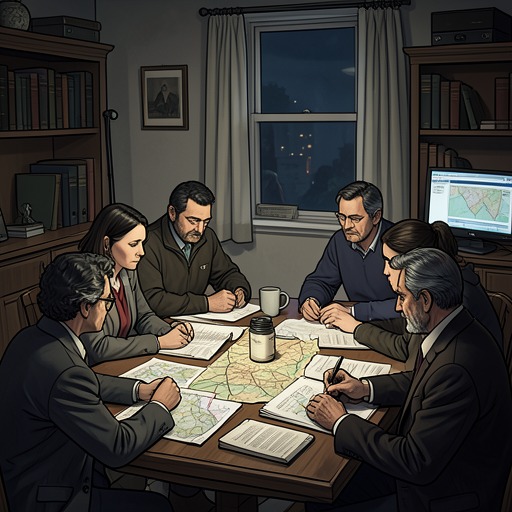
The Kid’s research began from the case’s geographic pattern. McNamara describes a limited pool of white men born between approximately 1943 and 1959 who had lived or worked in Sacramento, Santa Barbara County, and Orange County during the crimes’ active years, 1976 to 1986. The Kid searched that possibility systematically, cold-searching sources that included Ancestry.com and USSearch.com. He also acquired a copy of the 1977 R. L. Polk Sacramento Suburban Directory through eBay and digitized the 1983 Orange County telephone directory onto his hard drive.
His scale of effort distinguished him from a casual message-board participant. McNamara estimates that he had spent nearly four thousand hours mining potential leads. When she sent him a suspect she had become excited about, he replied that the name had not been a serious candidate for some time. He had been researching for about a year longer and had consulted several databases beyond her own work; he sent her the suspect’s sophomore-year photograph and placed him outside his leading group. The exchange exposed the danger of falling in love with a promising name before testing it against the larger field. It also showed the practical value of accumulated research: what felt to McNamara like a fresh breakthrough could already have been examined and set aside.
The clearest record of his method was The Master List, a 118-page document containing roughly two thousand men, with dates of birth, address histories, criminal records, and photographs when available. It was indexed, and some entries carried terse notes whose significance depended on familiarity with the case. The list joined disparate traces into a searchable working archive; its size testified to sustained labor, while its organization made that labor usable by others. Yet it did not turn a broad pool of possibilities into certainty. The scale of the list was evidence of diligence, not proof that any one candidate was the killer.
Testing Suspects and the Limits of Description
The Kid’s resistance to premature certainty appears in his handling of McNamara’s proposed suspect. Rather than echo her excitement, he placed the man outside his top tier and supplied the photograph from his earlier research. The moment is a small but consequential correction: an investigator’s attraction to a possible answer can outrun the evidence, while a more comprehensive comparison may have already weakened the case for that person.
He also demonstrated how readily a suspect profile can mislead when treated as identification. Based only on geographic history and physical description, he observed, an investigator could produce a profile that fit Tom Hanks. The example was deliberately absurd as a final suspect identification; Hanks could be excluded by the production schedule of Bosom Buddies. The point was methodological rather than accusatory. Location and appearance can generate candidates, but neither alone distinguishes a real perpetrator from someone who happens to match broad characteristics. The Kid’s work therefore functioned both as a search and as a warning against mistaking resemblance for proof.
Motivation, Obsession, and Collaboration
The Kid explained his interest in a short statement prepared for investigators who might encounter his research. He described it as difficult to summarize: a large question with a simple answer had compelled him to find that answer. The formulation captures the pull of the case without suggesting that research had brought him close to a resolution. His investment was also practical in a less comfortable sense. In an email to McNamara, he acknowledged that the more time and money he put into an endeavor others might regard as impractical or inexplicable, the more driven he became to identify the killer and justify that investment. He anticipated that he would eventually have to walk away and resume his life, even as the accumulated cost made continuing feel increasingly necessary.
That tension places him within the broader problem McNamara describes: the search can become self-reinforcing, because each hour already spent seems to demand another. The book does not present his diligence as a diagnosis, nor does it treat his work as a substitute for law enforcement. Instead, it records both the value of his method and the personal pressure built into an unresolved investigation. Other message-board participants faced contempt from a critic who dismissed them as untrained meddlers; the Kid’s documented work gives a concrete counterpoint to that caricature, while his own admission about time and money shows that commitment has costs even when it is productive.
After McNamara died, the Kid’s role changed from a researcher whose findings she consulted to a collaborator helping preserve and organize her unfinished work. Identified in the posthumous account as Paul Haynes, her lead researcher, he worked with investigative journalist Billy Jensen to tie up loose ends and prepare the materials for publication. A week after her death, they gained access to her hard drives and began exploring 3,500 files, alongside notebooks, legal pads, loose notes, digitized police reports, and thirty-seven boxes of records from the Orange County prosecutor that McNamara had called the Mother Lode. This later work extended his contribution beyond candidate searches: he helped make a vast, unfinished investigation legible to readers. The account nevertheless preserves the limit at its center. No research archive, however carefully built, could supply the one person who knew the puzzle’s complete design: the killer himself.